

Facilitator notes
Here's a simple way to structure it so people leave with a real, working query rather than just a concept.
Before you start
- Have the three skills installed and working on your own machine so you can demo live — a working example beats slides.
- Ask each person to bring one real strategic question they actually care about. The session is far stickier when the work is their own.
- Pick one shared question up front to walk through together before people go solo.

Customer discovery
Atlassian AI Builders Week curriculum
Take what's relevant and make it your own.
The solution: three layered skills
Data Signal Sources (the foundation)
A core skill that encodes best practices for:
- PII scrubbing — customer names, contacts, and sensitive data are protected by default.
- Authorization — appropriate access controls per data source.
- Querying protocols — maximize depth and breadth of retrieval for LLM ingestion.
- Usage guidelines — when and how to use each source for different query types.
This is the source of truth that all other skills build on. It prevents context rot by ensuring you're always querying authoritative, original sources — not derivative content. For us, that meant 12+ pinned sources — support tickets, voice-of-customer feedback, sales call recordings, research repositories, and more. Yours will be the systems your organization already uses.
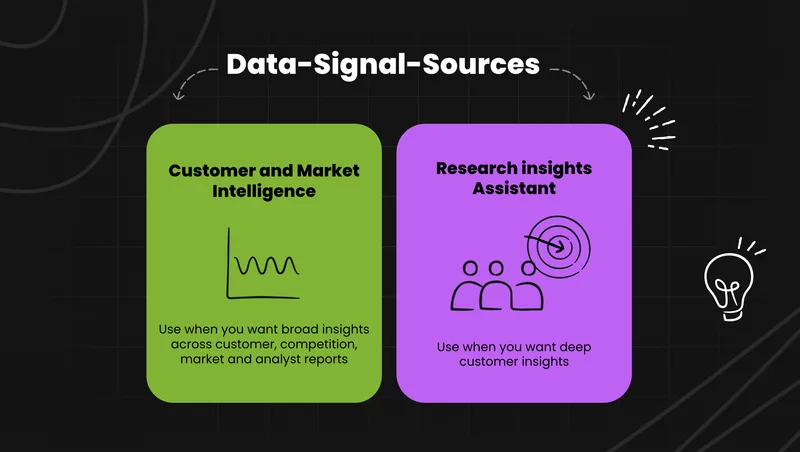
Customer & Market Intelligence (CMI) — broad landscape
Use this for open-ended strategy questions when you want a wide scan before narrowing focus.
Best for:
- What customer signals exist on a topic?
- What does the competitive and market landscape look like?
- Opportunity sizing and product usage trends.
- Generating strategy hypotheses to test.
How it works:
- Ask your open-ended question.
- CMI queries Data Signal Sources and identifies which have relevant evidence.
- It returns a structured set of sub-questions and recommended sources.
- You can refine scope (e.g. exclude community data, focus on your largest customers).
- It generates a structured research report — themes, customer counts, signal strength by source.
Output: A research report showing the landscape of evidence, how much is available, and where it lives.
Research Insights Assistant / REA — deep validation
Use this to pressure test hypotheses with direct customer evidence and quotes.
Best for:
- Validating or challenging a hypothesis that came out of CMI.
- Finding customer quotes that support or contradict a strategic direction.
- Raw transcript analysis and deep dives into specific customer conversations.
- Summarising what customers are saying or doing on a particular topic.
How it works:
- Paste in hypotheses from CMI (or your own).
- REA queries the same sources with protocols optimized for qualitative data retrieval.
- Returns evidence for and against each hypothesis with direct customer quotes.
- Provides directionality — not just "strongly supported" but what blockers, gaps, and trust issues exist.
- Flags confidence gaps and can draft a research request for follow-on studies.
Output: A hypothesis assessment with customer-backed evidence, directionality, and a recommended path forward.
The full workflow in practice
Here's the end-to-end flow from question to strategy proposal in minutes:
Strategic question
Quick directional scan (e.g. support tickets + voice-of-customer feedback)
CMI Skill (broad landscape, competitive context, hypothesis generation)
REA Skill (deep validation with customer quotes and directionality)
Combined CMI + REA → Senior leadership strategy proposal
Important guardrails
- No marketing use. Customer names or signals surfaced through these skills cannot be used for sales or marketing campaigns.
- Use for: strategic product direction, identifying candidates for follow-on qualitative research, informing roadmap decisions.
- Know your sources. Sales call recordings tend to be rich, structured, and well suited to keyword search and qualitative parsing. More unstructured sources (like ad-hoc video recordings) may carry AI fair-use restrictions — use with care.
- Check access and licensing early. Relevant data for PMs and designers often lives in tables the skills can reach without everyone needing individual licences to each tool.
What this changes
| Before | After |
|---|---|
| Weeks assembling research, data science, sales, PM, design | Minutes for a first-pass scan |
| Each PM re-plumbing the same sources independently | Shared foundation everyone builds on |
| Surface-level questions to data science and research | Show up already informed; partner on net-new deeper analysis |
| Single data source giving a partial picture | 12+ sources queried consistently with best-practice standards |
This doesn't replace qualitative research or data science. It means you stop bringing them open-ended surface scans — and start bringing them informed questions worth their time.
Getting started
Bundle your skills together so your team can install them in one command. They work in Rovo CLI, Cursor, Claude Code, and anywhere that reads from your local .agents/skills library — the agent will automatically select the right skill based on your question. The three skills above are how we structured ours; your data sources and skill boundaries will look different based on your own organization's tools.